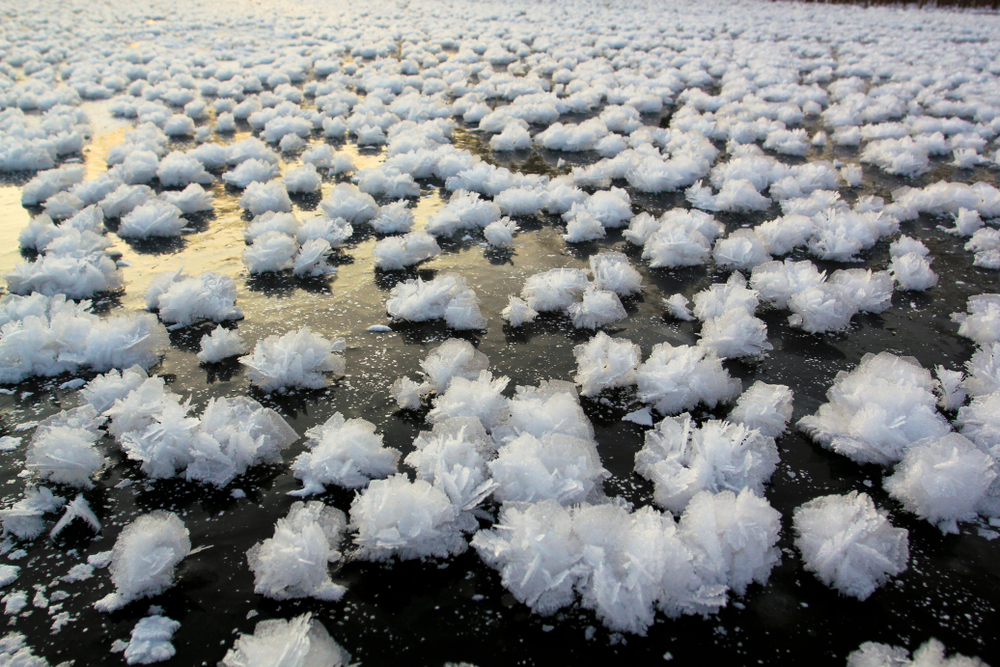

I first heard about Frost Flowers in the waters of the Artic, but when I started looking into the science behind how they formed I discovered that similar structures also appear on land, and in freshwater.
The ones that develop on the surface of the sea and the ones that appear on land are both formed from frozen water, and they require very cold air temperatures to develop, but that’s where the similarities end.
Frost Flowers on land appear on living wood, often on stems, because their development requires that the outer surface of the wood freezes and splits. this opens up a channel where the water in the plant oozes out of the crack and freezes to form brittle, hairlike structures. They grow from the base, like grass, and often bend into curves as the weight of the emerging ice threads slowly pulls them down as they increase in length.
When they grow on the sea its a slightly different process. They’re still formed from frozen water but they’re extermely salty, which seems odd because salt water doesn’t freeze. Icebergs are not salty. When a solution such as seawater (brine) freezes, only the water molecules join together to form ice crystals. Anything dissoved in the water doesn’t become part of the ice, it gets left behind – so when an ice crystal forms in a solution, the remaining unfrozen solution becomes more concentrated.
How then do we get salty Frost Flowers?
Well, it’s due to the way they form, and to understand how that happens, we have to know a bit more about ice and sea ice.
Most things expand as they get warmer, and conversely contract as they get cooler, which is how a mercury thermomether works. and why engineers freeze bearings in liquid nitrogen so they will fit into a hole that’s actually too small for them and create a tight fit when they warm up.
Water is different. Below about 4°C water stops contracting and begins to expand, which is why ice floats, because it’s less dense than water, This is why we get a layer of ice on top of rivers and lakes which helps protect the water beneath from freezing. If water didn’t do that the rivers and lakes would freeze solid in the cold weather and all the life would be killed. We probably wouldn’t exist.
With salt water it’s different. I’m going to quote the National Sea Ice Data Centre because I really can’t think of a better way to explain it:
“Sea ice forms more slowly than freshwater ice for two main reasons. First, the freezing temperature of salt water is lower than freshwater; ocean temperatures must reach -1.8°C (28.8°F) to freeze. Secondly, in contrast to fresh water, the salt in ocean water causes the density of the water to increase as it nears the freezing point. As a result, salt water sinks away from the surface before it cools enough to freeze. Generally, the top 100 to 150 meters (300 to 450 feet) of water must cool to the freezing point for sea ice to form.”[1]
Lots of processes are at work in the formation of sea ice. When it does begin to form it tends to be in the form of needle-like crystals called frazil. The can then combine into pads known as pancakes, which can then overlap and clump together to form more solid layers. Although the frozen water doesn’t contain salt it does trap pockets of brine which concentrate as growing ice takes more water out of them. They’re also washed away when ice partly melts and refreezes, meaning that the ice structure contains fewer brine pockets as it ages.
What we’re interested in for explaining the growth of Frost Flowers on the sea is a certain type of ice formation called nilas which develops when needles of frazil clump together in very still conditions to form smooth sheets up to 10cm thick. Below about 5cm, the sheets appear dark – not surprisingly called dark nilas [2]– which is why it appears on many photographs as if the Frost Flowers are growing in the water. If you look closely at the featured image at the top of the article you’ll see that the surface upon which the flowers are growing is smooth, dark ice – not water.
Nilas ice is relatively thin and flexible, in the sense that it cracks easily with movements of the water, and this is where Frost Flowers begin to grow. Just like water vapour needs some form of nucleus to grow around to condense into raindrops, the mechanism that produces Frost Flowers needs some discontinuity on which it can grow. Just like land-based ones, they rely on extremely cold air supersturated with moisture which can begin to form solid ice crystals on the surface imperfections of this cracking nilas ice layer.
So, they don’t form as a result of liquid water exuding from a split or a channel and grow from the base of the filaments, like grass, in the way that land-based Frost Flowers do (Fig. 2), they form on imperfections, nucleation sites, on the surface of ice, and grow by attracting moisture from the surrounding air, like snowflakes (Fig. 1).
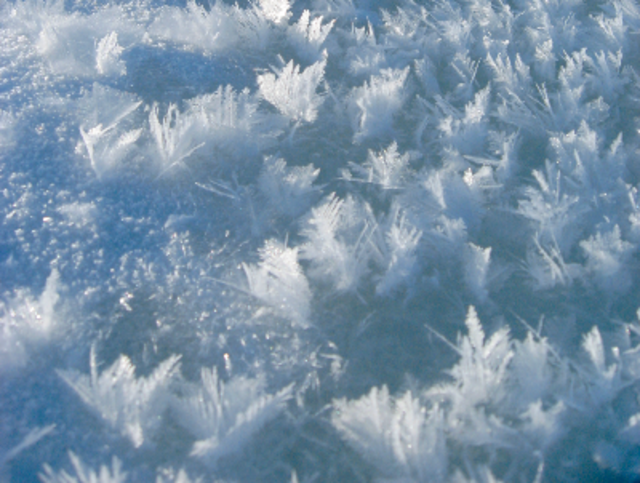
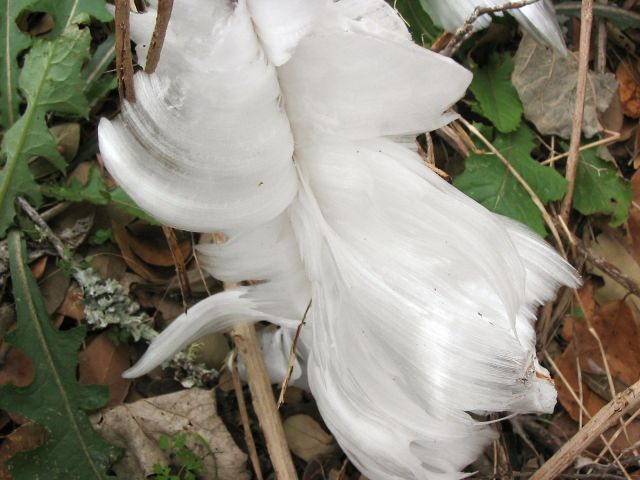
This is why the two forms look very different to each other.
But the saltiness? If they’re growing by pulling water from the air, and not from the sea you’d expect them to be made of pure water.
This is where it gets fascinating. They develop in the form of hollow tendrils, tubes, which draw brine up from the nilas[5], which is a conglomeration of ice crystals and pockets of brine. This means they are not salty as such, they’re more like a ice sponge containing salty water, which of course does not freeze because it has a lower freezing point than the tubes.
As might have been expected, analysis showed the concentrated brine also contained microbes and other substances, but what was perhaps not expected was the discovery that the concentration of microbes in the ‘flowers’ was greater than that of the seawater. It’s composition was also different. When exposed to sunshine, these Frost Flowers develop into complete ecosystems which have an effect on the ozone concentrations of the surroundings. They also synthesise substances which return to the larger environment when the structures melt.
At any given time during the polar winter and spring there may be thousands of square kilometres of these Frost Flower fields in the Arctic[6] and the effects on the overall environment of these ‘temporary factories’ are little understood. We therefore do not know what the consequences are if we continue to lose polar ice.
Further Reading
- [1] National Snow and Ice Data Center, How sea ice forms: https://nsidc.org/learn/parts-cryosphere/sea-ice/science-sea-ice#anchor-how-sea-ice-forms
- [2] Australian Antarctic Program, Development of sea ice: https://www.antarctica.gov.au/about-antarctica/ice-and-atmosphere/sea-ice/development-of-sea-ice/
- [3] Triboy123, Public domain, via Wikimedia Commons
- [4] Claygate, Public domain, via Wikimedia Commons
- [5] Grist,The Arctic’s beautiful frost flowers are home to millions of microbes: https://grist.org/article/the-arctics-beautiful-frost-flowers-are-home-to-millions-of-microbes/
- [6] Journal of Geophysical Research: https://agupubs.onlinelibrary.wiley.com/doi/full/10.1029/2011JD016460