
This ‘problem’ continues to circulate online like a bad penny[1]. Like the question of whether an aircraft can take off if you put its wheels on a conveyor, it keeps cropping up when really it’s been done to death and you’d think everyone would have agreed and understood it by now.
Apparently not because it appears to still attract the same comments, so perhaps we can think about it in a different way.
The problem – if you don’t already know it – is this:
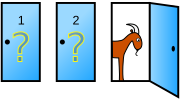
Suppose you're on a game show, and you're given the choice of three doors: Behind one door is a car; behind the others, goats. You pick a door, say No. 1, and the host, who knows what's behind the doors, opens another door, say No. 3, which has a goat. He then says to you, "Do you want to pick door No. 2?" Is it to your advantage to switch your choice?
It seems a simple suggestion, but caused a huge problem when first proposed because even academics ‘bought into’ the wrong assumption.
If you look up the solutions on Wikipedia you will probably also be confused, and rightly so.
Let’s simplify the problem because it doesn’t matter whether you won a car or a goat. That’s just irrelevant unless you particulary like goats. You win a prize or you lose. One door wins. The other two don’t have anything behind them.
- You pick a door, which has a 1:3 chance of being the winner.
- Since only one door is a winner, at least one of the other two must be a loser – so there is always one that can be opened to reveal no prize.
- Is it now better to change your choice to the other door?
Some would say it makes no difference because all doors have a 1-in-3 chance of revealing the prize.
Some will argue that it is better to change your mind, and will go about quoting horribly complex mathematic formulae, or convoluted assertions to back this up.
I will not repeat them here because you can go and look them up.
The simplified choice is this:
- You pick one of the three doors. This has a 1:3 probability of revealing the prize.
- Now two doors remain. The probability it is behind one of those is 2:3.
- Do you want to change your mind and bet that the prize is behind one of those.
But, you say, this isn’t the same problem! Yes it is absolutely the same problem. It makes no difference whether the host opens one of the doors or not. There is always one door he can open because the prize cannot be behind both of them. It may not be behind either but that is a 1-in-3 chance – which is the probability it’s behind the one you originally chose.
He has told you nothing new by revealing one ‘losing’ door. The trick is to offer you the choice of changing your mind and selecting the remaining one. By choosing it you are really choosing both of them – the one he just opened and the remaining unopened one.
No new information has been revealed by showing you one door that it is not behind. There was always one of those doors that led to no prize.
The real choice is: Do you want to change your mind and bet that it’s really behind one of the two remaining doors?
Of course it’s better. That’s the 2-in-3 chance. The fact that one of those is now open and the prize wasn’t behind it doesn’t change those odds. They would be the same if he just showed you both closed doors and asked whether it was more likely to be behind one of those.
The confusing thing is it that you’re seemingly being offered one door now as an alternative – but that one door is really both of the ones you didn’t originally choose. Just calling it one door because you’ve opened the other doesn’t alter the odds.
The question really is:
- Pick a door
- Do you want to change your mind and bet it’s behind one of the other two?
Yes – I bet it’s behind one of the two I didn’t choose. I know it isn’t behind both so whether you reveal one of the losing doors before I change my mind or not doesn’t alter anything. You’ll always selectively pick one that isn’t a winner.
If one of the two doors was opened at random that would be the winning door in 1-of-3 cases , so you’d know you’d lost straight away, but what you’re doing is deferring that knowledge until you make your choice.
Don’t simplify the solution – simplify the question.
Is it behind the one you originally chose or is it behind one of the other two? Being shown it’s not behind one of them tells you nothing because you already knew that.
Actually – I quite like goats…
Further Reading
Featured image: By Cepheus – Own work, Public Domain, https://commons.wikimedia.org/w/index.php?curid=1234194
- [1] BookBrowse: https://www.bookbrowse.com/expressions/detail/index.cfm/expression_number/154/a-bad-penny-always-turns-up