
One of the enduring paradoxes I remember from my time at school was that of The Train and The Fly. It puzzled a lot of people until my physics teacher explained to us all how to overcome the paradox. The answer turned out to not just be about the train and the fly, but about how we view the world and how we perceive reality.
The problem is this:
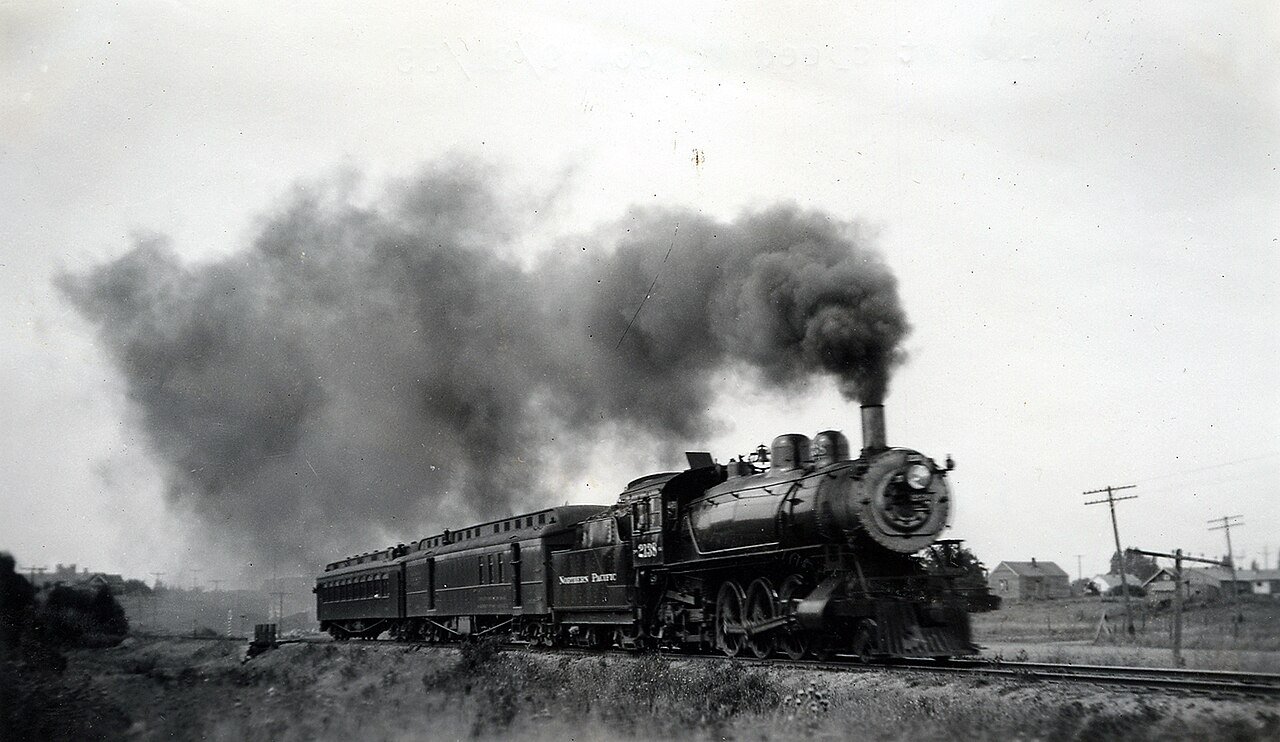
We have a train, a great big metal monster, thundering along a track at full speed. You have to agree that it carries with it a lot of energy. Travelling in the opposite direction, there’s a fly. Tiny little thing.
At some point, the fly and the train collide head on. The fly of course is now stuck to the train and travelling in the opposite direction.
This is obvious, and causes no problem at all, until you realise that you can’t reverse direction without stopping. In order to be travelling in one direction, and then be travelling in the opposite direction, the fly must have stopped. That is indisputable.
The problem is that, if the fly was stuck to the front of the train when it changed direction, the train must have stopped too.
At some point in time, the fly stopped the train.
Okay, you can argue that the fly will have deformed, and won’t have changed direction all at once, or it may have momentarily bounced in the layer of air that sits in front of the train, or many other scenarios which don’ t involve a simple direct collision. These are all legitmate ways of attempting to solve the problem by ‘softening’ it – by looking at alternative ways that the fly might have changed direction without stopping. Swap ‘fly’ for ‘tiny piece of plasticine’. In this situation it makes no difference whether all of it reverses direction at the same instant, or whether it squashes up as it hits and some of it changes direction before the rest. The thing is that, at some point, the bit that is in contact with the train must have stopped in order to now be going backwards.
So how does a fly stop a train?
The answer is to do with the concepts of speed and time, and there are also two ways to look at what happened.
In the first scenario, we are describing events from the viewpoint of an observer who we assume was standing on the ground watching. The train is coming one way, the fly is coming the other way, they collide and the train continues blissfully on it’s journey completely unscathed. If we were to look at the events as a movie that is waht we would observe. But now look at what we see when we look at the frames of the movie. By comparing the position of the train and fly between one frame and the next, we could calculate their apparent speeds. At some point we would see that the fly was stuck to the train and we’d calculate their speed, again from one frame to the next. The fly is now going backwards.
Mmmm. Do we have a frame showing the point of collision – where the train an the fly meet? Let’s say by great fortune we do. Comparing this with the frames either side we’d calculate the speed of the fly and observe it has changed direction.
If we had a faster frame rate we’d see the same thing but the distances moved would be smaller so the calculations would be less accurate. However you look at it, and however short you make the time interval between observations, the train and the fly will never be stationary.
There may well be a frame taken at the exact time the fly touched the train, but you cannot say what the speed of either of them were at that instant. They both appear stationary in every frame, because those frames represent an single point in time. You need to look at their positions at some time either side.
There is no motion at an instant in time (Fig. 1). It’s a meaningless thing to say.
There is another way to look at the scenario, and that is from the viewpoint of someone on the train.
The fly comes along, hits the front of the train, and stops. It would make no difference whether the train was moving or not. The fly hits the train and it stops. There’s nothing contentious about that. It’s only when we view the events from the position of an independent observer, a third party not connected to them, that we observe things that confuse us.
For anyone, to calculate or even have the concept of speed involves a time interval. Interval meaning change. You can calculate the exact position of the train and the fly in any frame – in other words at any instant in time – based on the view in that frame. If you want to calculate the speed of them you need to observe them over a time interval, but their exact position over a time interval is not definable – all you can say is they were probably somewhere between their positions at the start and end of the time interval, which is just a guess because you don’t know where they went in between.
Once you understand that you can’t accurately measure both position and speed at the same time, and that things can look vastly different to different observers, Messrs. Heisenburg and Einstein would like a word.
Featured image: Steve Shook, CC BY 2.0 https://creativecommons.org/licenses/by/2.0, via Wikimedia Commons
- [1] Soham Banerjee from Bangalore, india, CC BY 2.0 <https://creativecommons.org/licenses/by/2.0>, via Wikimedia Commons