
While talking about Water Security in Africa I mentioned that Egypt grow what is regarded as the best cotton the world, but also use a lot of water which is badly needed by the other African countries upstream along the Nile – which is why you may or may not wish to buy it – and that led to me promising to write an article about cotton and how it’s possible to verify the source of cotton products.
I sincerely wish I had not, for it is far more complicated than I had imagined.
Cotton is a cellulose fibre of the genus Gossypium[1] and is grown from seed in warm climates across many part of the world.
It has reportedly been found in Mexican caves dating back to 5500 BC[2] and was certainly being grown elsewhere in the world many thousands of years ago – notably in Peru[3] and Mexico[4] and the Jordan Valley, and it was apparently introduced to the Greeks and Arabs by the invading army of Alexander the Great in about 300 BC[5].
What’s clear is that it’s been around for thousands of years and it’s now a widespread cash crop in many regions, accounting for about 25 million tonnes annually in 2025. On a worldwide scale, India produces the most, but the United States is the largest exporter of it, implying that India uses more, which is not surprising considering the impact that Indian cotton textiles have made on the world economy since they began to become popular in 17th and 18th century France[6].
Gossypium is a shrub that grows cotton bolls, which are filaments of cellulose, and the quality of the cotton is related to the length and diameter of the filament, called the staple. Long, thin staples produce materials with a softer, more luxurious, feel than shorter, thicker ones.
There are four main species of Gossypium, each of which is suited to cultivation in a particular soil and climate. Not surprisingly, the staple length, thickness, and strength varies between species, so cotton from different parts of the world is classified differently[7] and the varieties are used for different purposes[8].
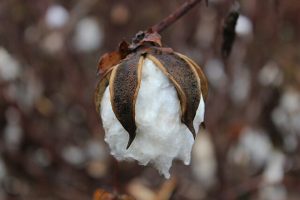
All varieties grow as a bush and develop ‘squares’ which are the precursor to ‘flowers’ that subsequently fill out with cotton filaments to become ‘bolls’ and eventually burst (Fig. 1), revealing tufts of cotton fibre ready for picking[9]. Each phase of development requires a number of warm days, and the baseline for these are 60°F (about 16°C) so they are known as DD60 days. This of course limits the regions in which cotton can be grown because you need the required number of DD60 days where the temperature exceeds 16°C for each growth phase to develop.
The other critical factor is water. Cotton is reasonably drought-resistant, but it does require more water during certain stages of its growth[10]. Some regions rely on rainfall for this, while farmers in other regions actively irrigate crops. While the plant species (variety) is the main factor affecting the fibre length, it is the water availability which determines whether the plants will actually produce their best quality and yields.
While people like to tell themselves that cotton, and especially organic cotton, is an environmentally-friendly alternative to man-made fibres, it is said to be a water-intensive crop, and the environmental advantages of growing it can be far-reaching. Cotton production is quoted as having serious effect on the Indus Basin in Pakistan, in areas of China, and the Murray-Darling Basin in South Australia[12] – where the author grew up.
The most prized of these varieties is the Egyptian Giza 45[13] which is grown in the Nile Delta, and here is where the puzzle begins.
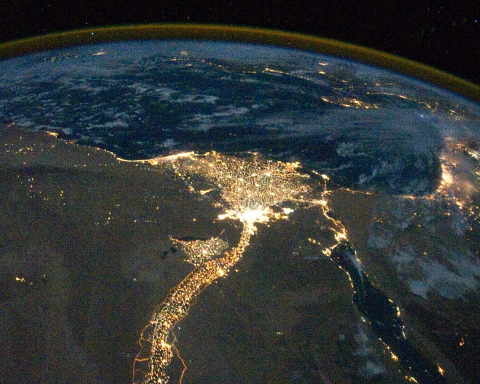
Agriculture along the Nile Valley takes place in the nutrient-rich fertile plains consisting of black silt which is carried down the river and deposited during the summer floods (Fig. 2). The flow of the Nile in Egypt is moderated by the High Aswan Dam, which creates an enormous reservoir in the form of Lake Nassar[14]. Farming here therefore benefits from the deployment of an advanced artifical irrigation infrastructure[15], creating near-perfect conditions for the production of cotton.
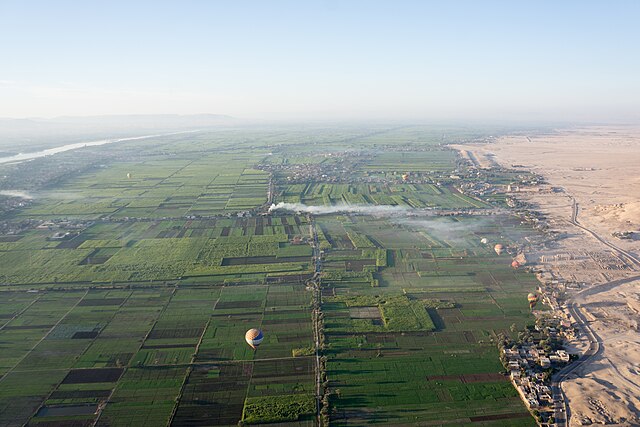
Agriculture is only possible in the flood plain, where summer flooding carries nutrient-rich silt, and where irrigation is possible using water from the river.
Due to the Nile River Agreement, which effectively prevents countries upstream of Egypt from damming or extracting water that would affect the flow to the downstream countries, particularly at the expense of Ethiopia[17], but nevertheless affecting all the upstream countries that share a bank of the river (riperian countries), Egyptian cotton has become an especially controversial topic, as growing it in Egypt uses water which deprives other African people of a much needed resource.
Some have questioned whether cotton really is such a water-intensive crop, and a search for ‘myth of cotton being a water-intensive crop’ reveals many rebuttals – too many to list here. Many of these are written by the cotton industry or suppliers. This of course doesn’t mean they are necessarily biased, but it is hard to find independent sources to demonstrate this.
It may in fact, be more of a case that the methods of production are more wasteful of water. Some types of irrigated plantations are more likely to expose a lot of water to evaporation. One argument I looked at briefly was taking the stance that the plants don’t use a great deal of water and most of it returns to the atmosphere either by evaporation or through the transpiration of the plant, which means it’s not consuming a lot of water at all because most of it returns to the water cycle. This may be true, but that argument totally ignores the cost of making the water available – the assumption being that if it falls from the sky it’s free – whereas most of the challenge of water is storing it and getting it to where it’s needed, which is why even wet countries like the United Kingdom suffer from water shortages from time to time.
My intention here is not to judge the merits of any of these assertions, but only to raise awareness of the fact that Egyptian cotton production uses water which is effectively ‘robbed’ from other African countries as a result of an old colonial agreement, and perhaps this should be the factor in considering the moral stance on encouraging its consumption.
Given that, how does a consumer determine where their cotton articles come from? You may say “Read the label”, but this is frought with uncertainties. Many goods are produced using mixed cotton fibres, and both suppliers and manufacturers have difficulty verifying exactly what they’re buying. As different varieties grown in different countries produce different staples, it would seem that analysis should be simple, but as with most assumptions, it isn’t. Quite often, cotton from different farms becomes mixed as soon as it leaves the gate. In the old days of American cotton production, the farmers would gather their bales at the levee on the banks of the Mississsippi, and await the arrival of the Robert E. Lee paddle steamer to take their harvest to New Orleans[18].
Even today, cotton processing facilites feed their lines continuously, so cotton brought in from many sources becomes mixed. Unscrupulous suppliers lay claim to the provenance of their materials to get the best deals they can. Sometimes even they have no means of truly knowing where it came from. Cotton fibre is the equivalent of the ‘Persian Carpet’ touted by the merchant in the souks of Africa, which is neither a genuine Persian carpet, nor is a hundred years old, but which is of questionable origin and probably made by their brother two weeks ago.
Both the industry and the consumer have long sought ways to track cotton fibre from farm to finished material. Many countries have put methods in place to track food from farm to table[19], but the challenges of tracing cotton fibres are manifold because it is grown is over 75 countries, from suppliers with vastly different levels of technology and who already comply with different, and perhaps conflicting regulations, or none at all[20], and developing tracability is an ongoing global challenge[21].
Another possibility is to identify origins forensically. Cotton seeds have DNA, but the cellulose fibres don’t, so it is necessary to resort to other indicators[22]. As they grow and develop, organisms take up elements from the environment. This provides them with a chemical identity, known as an Isotopic Fingerprint which can be used to identify their origin[23].
In the absence of forward traceability – a log of movements from source to destination – this type of laboratory analysis is a form of determining backwards traceability – after the event so to speak, which is difficult if you are dealing with a mixed mass of fibres or a finished item of clothing.
Further Reading
- Water Security in Africa
- Cotton, Colonialism, and Consumerism: How Indian Cotton Shaped Global Trade
- An Introduction To Cotton Varieties
- Growth and Development of a Cotton Plant
- Historical Roots of the Blue Nile Conflict between Egypt and Ethiopia and its Present Reflections
- [1] Royal Botanical Gardens, Plants of the World: https://powo.science.kew.org/taxon/urn:lsid:ipni.org:names:30013018-2
- [2] Jonathan D. Sauer, Historical Geography of Crop Plants: A Select Roster, Routledge (2017), p. 115
- [3] New World Cotton, p. 117, at Google Books in Manickam, S.; Prakash, A. H. (2016). "Genetic Improvement of Cotton". Gene Pool Diversity and Crop Improvement. Sustainable Development and Biodiversity. Vol. 10. pp. 105–161. doi:10.1007/978-3-319-27096-8_4. ISBN 978-3-319-27094-4.
- [4] Huckell, Lisa W. (1993). "Plant Remains from the Pinaleño Cotton Cache, Arizona". Kiva, the Journal of Southwest Anthropology and History. 59 (2): 147–203. JSTOR 30246122
- [5] Wired Magazine: https://www.wired.com/2013/08/the-most-bonkers-scientific-theories-and-why-you-should-be-thankful-for-them/
- [6] Sanjit Dhillon, Textile Museum of Canada: https://textilemuseum.ca/collection/cotton-colonialism-and-consumerism-how-indian-cotton-shaped-global-trade/
- [7] Textile Exchange [PDF]: https://textileexchange.org/app/uploads/2021/04/00_OrganicCottonFiberClassification_Guide2017_FINALforpublishing.pdf
- [8] English Fine Cottons: https://www.englishfinecottons.co.uk/journal/manufacturing/an-introduction-to-cotton-varieties/
- [9] National Cotton Council, Growth and Development of a Cotton Plant: https://www.cotton.org/tech/ace/growth-and-development.cfm
- [10] National Cotton Council, Water Management: https://www.cotton.org/tech/ace/water-management.cfm
- [11] Michael Bass-Deschenes(Commons User Mike Bass-Deschênes), CC BY 2.0 <https://creativecommons.org/licenses/by/2.0>, via Wikimedia Commons https://commons.wikimedia.org/wiki/File:Cotton_boll_nearly_ready_for_harvest.jpg
- [12] EJF, The True Costs of Cotton Production and Water Insecurity: https://www.googhttps://ejfoundation.org/resources/downloads/EJF_Aral_report_cotton_net_ok.pdf
- [13] Giza Cotton LLC: https://www.gizacotton.com/cotton/giza-45/
- [14] Institution of Civil Engineering, Nile Water Control: https://www.ice.org.uk/what-is-civil-engineering/infrastructure-projects/nile-water-control
- [15] Nile Water Lab: https://nilewaterlab.org/realities/colonising-for-cotton/
- [16] Fanny Schertzer, CC BY-SA 4.0 <https://creativecommons.org/licenses/by-sa/4.0>, via Wikimedia Commons
- [17] Center for Middle Eastern Studies, Historical Roots of the Blue Nile Conflict between Egypt and Ethiopia and its Present Reflections: https://orsam.org.tr/en/yayinlar/historical-roots-of-the-blue-nile-conflict-between-egypt-and-ethiopia-and-its-present-reflections/
- [18] Channel Islands Maritime Museum: https://www.maritime-museum.org/north-gallery/robert-e-lee/
- [19] FoodUnfolded,Tracing your food – Understanding its journey from farm to table: https://www.foodunfolded.com/article/tracing-your-food-understanding-its-journey-from-farm-to-table
- [20] Oritain, Dr. Kate Jones | 5 December 2024, Cotton Traceability Challenges in Global Supply Chains: 7 Barriers and How to Overcome Them: https://oritain.com/resources/blog/7-cotton-traceability-challenges-global-supply-chains-how-to-overcome-them
- [21] Fashion Sustainability Directory, What Are the Key Challenges in Tracing Cotton through the Supply Chain?: https://fashion.sustainability-directory.com/question/what-are-the-key-challenges-in-tracing-cotton-through-the-supply-chain/
- [22] Interline, Origin of Material Matters – Isotopic vs DNA Testing for Cotton Traceability: https://www.theinterline.com/2024/08/29/origin-of-material-matters-isotopic-vs-dna-testing-for-cotton-traceability/
- [23] ISO Food EU,What is an (isotopic) fingerprint or signature?: https://isofood.eu/faqs/what-is-an-isotopic-fingerprint-or-signature/